
Official Course: Virtual Private Network (VPN) on OPNsense
Learn IPsec, OpenVPN, & WireGuard Through Practical Hands-On Labs on OPNsense
Watch Promo
What you'll learn
- Understand the fundamentals of Virtual Private Networks (VPNs) and the role they play in securing modern networks.
- Install, configure, and manage VPN services on OPNsense from scratch.
- Build secure Site-to-Site VPNs using IPsec to connect multiple office locations.
- Configure Remote Access VPNs using OpenVPN for secure user connectivity.
- Deploy and manage WireGuard VPN for fast, modern, and secure encrypted communications.
- Implement Multi-Factor Authentication (MFA) to strengthen remote access security.
- Configure firewall rules, routing, NAT, and DNS settings required for successful VPN deployments.
- Gain practical hands-on experience through real-world laboratory exercises that can be applied immediately in production environments.
Requirements
- Basic knowledge of IP addressing, subnetting, and routing concepts.
- Familiarity with general networking terminology.
- 2 OPNsense firewalls (physical or virtual) or a virtual lab environment such as VirtualBox, VMware, Proxmox, or GNS3 to perform the hands-on exercises.
Every lesson is demonstrated in a real lab environment, allowing you to follow along and gain practical experience that can be applied immediately in production networks. You will also learn best practices for securing VPN deployments, optimizing performance, and diagnosing common connectivity issues using OPNsense tools and logs.
- Network engineers who want to deploy secure Site-to-Site and Remote Access VPNs.
- System administrators responsible for managing firewalls and secure remote connectivity.
- Cybersecurity professionals looking to strengthen their knowledge of VPN technologies and secure network design.
- IT support engineers who troubleshoot VPN connectivity and authentication issues.
- Students preparing for careers in networking, cybersecurity, or system administration.
- OPNsense users who want to fully utilize its VPN capabilities, including OpenVPN, IPsec, and WireGuard.
- Anyone interested in learning practical VPN implementation through real-world, hands-on laboratory exercises.
Your Instructor
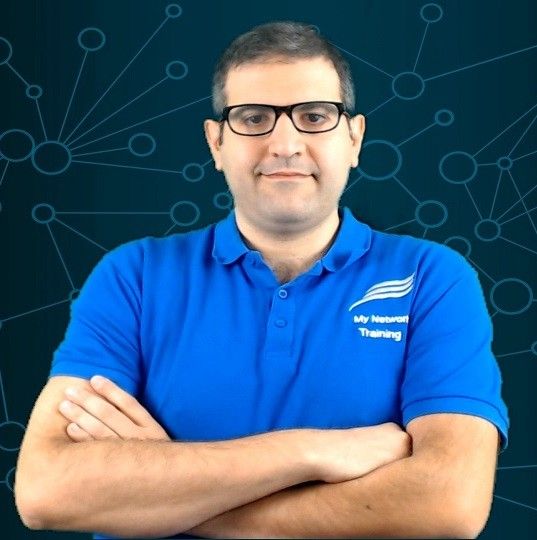
Hello everyone. My name is Maher Haddad and I am a Certified MikroTik Trainer, Cisco Authorized Instructor, IPv6 Forum Trainer and LigoWave Authorized Trainer.
I have decided to make this online school to share my knowledge to the community. All my courses are based on theory and hands-on LABS so you can practise while learning.
More than 100K happy students have joined mynetworktraining.com up to year 2026.
I hope you will enjoy watching my courses and see you inside!
Course Curriculum
-
Preview1- Understand how IPSEC works (10:15)
-
Start2- Understand how Router-Based IPSEC works on OPNsense (14:17)
-
Start3- Configuring Route-Based IPSEC with VTI on OPNsense (20:00)
-
Start4- Create the Static route over the Route-Based IPSEC to reach the Remote Networks (12:14)
-
Start5- Understand how Policy-Based IPSEC works on OPNsense (11:07)
-
Start6- Configuring Policy-Based IPSEC VPN on OPNsense (16:22)
-
Start7- Understand why same remote LAN subnets cannot communicate via IPSEC (9:36)
-
Start8- Configure IPSEC between 2 sites having same LAN subnet using BI-NAT on OPNsense (9:32)
-
Start9- Verify if the IPSEC is working on 2 sites having same LAN subnet on OPNsense (8:51)
-
Preview10- Explain what OpenVPN is and identify its advantages and disadvantages (7:08)
-
Start11- Configure the OPNsense firewall to act as an OpenVPN server (18:05)
-
Start12- Configure the OpenVPN client on the end device and connect to the OpenVPN server (7:00)
-
Start13- Configure the OpenVPN to work with 2FA on OPNsense (10:29)